
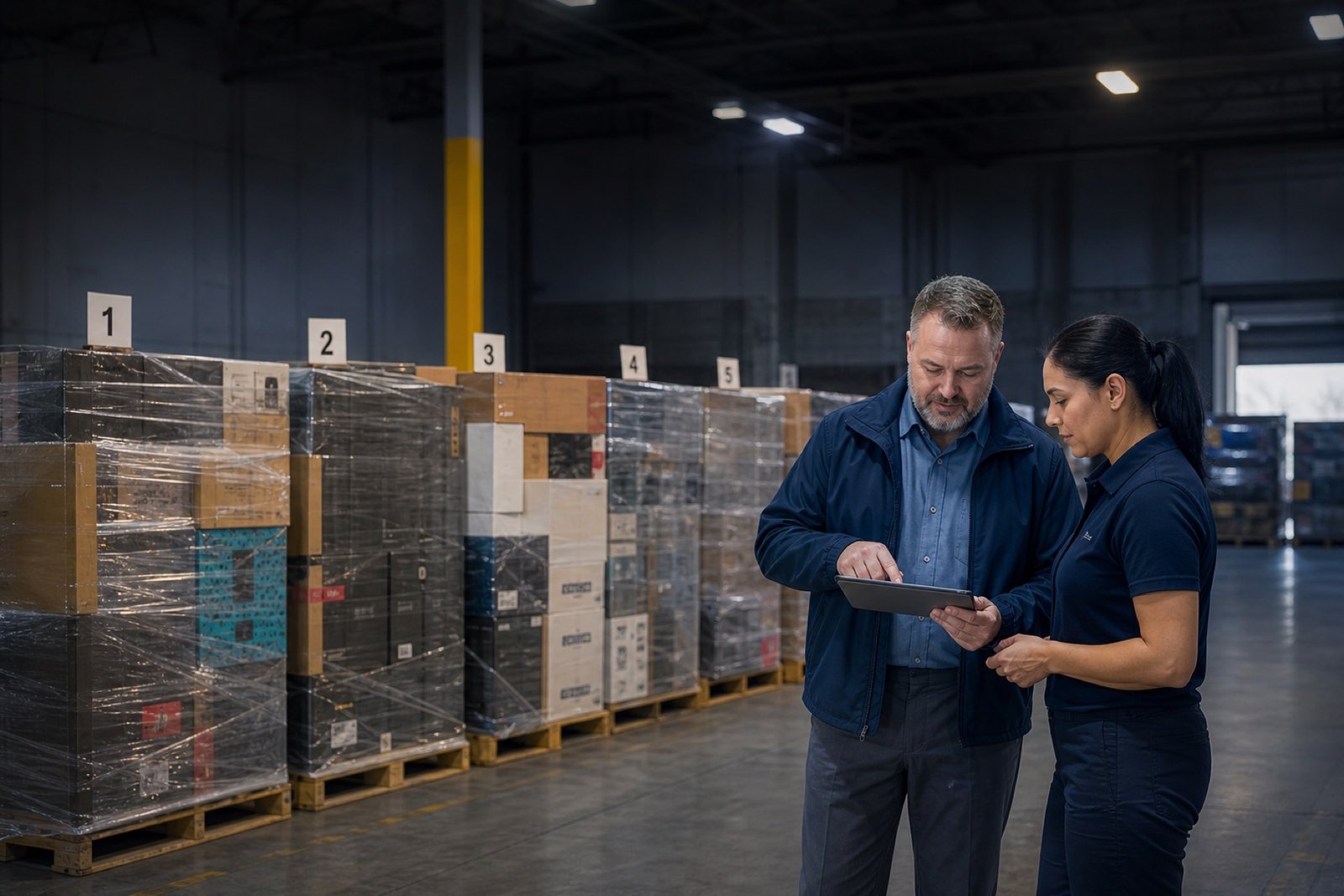
Buying Guides · 10 min read
Amazon Liquidation Pallets 💷 Landed Cost, Unit Economics, and Pricing the Risk
The arithmetic behind a liquidation buy: every cost line that is not on the listing, how to build a per-unit break-even, and why category and grade change the maths more than price does.
💷 The pallet price is the smallest interesting number in a liquidation purchase. Everything that determines whether a lot worked sits in lines that are not printed on the listing: getting it to you, getting it off the vehicle, getting it sorted, getting it photographed, storing what does not sell yet, and disposing of what never will. This guide builds the whole arithmetic in the order a warehouse would build it, so you end with a per-unit break-even figure rather than a feeling. Every number below is structural — you supply your own values, because ours would be meaningless in your operation.
💵 Listed pallet price · 🚚 delivery quoted to your postcode · 🏷️ grade stated before price.
Price a real lot while you read📥 Step one: landed cost, not pallet cost
Landed cost is what the lot has cost you by the moment it is sitting on your floor, wrapped and unopened. It is the pallet price plus the movement, plus anything the movement required — a liftgate because you have no dock, a residential surcharge, a waiting charge because nobody was there to receive it, or the fuel and hours if you collected it yourself. Collecting is not free; it is simply a cost you pay in time rather than on an invoice. Put a real figure on your own driving and you can compare the two options honestly.
🛠️ Step two: cost to make it sellable
Between the wrapped load and a listed item sits work, and that work is where most of the real cost lives. Receiving and destacking, triaging into buckets, testing, cleaning, re-boxing, photographing, writing listings, and packing. Price all of it at what an hour of your time is genuinely worth, not at zero because it happens in your own evening. If you would not do it for someone else at that rate, do not value it at that rate for yourself. This is the line that most often turns an apparently cheap lot into a poor one.
🗄️ Step three: carrying and clearing
Unsold stock costs space and it costs attention. Assign a weekly figure to the area a lot occupies while it clears, even if you own the building, because that space could hold the next lot. Then add the exit cost of the share that never sells: tip charges, recycling, or the trips involved in donating. Both lines are easy to leave out and both are entirely real. A lot that clears in three weeks and a lot that clears in three months are different purchases even when the invoice was identical.
| Line | What goes in it | Common mistake |
|---|---|---|
| 💵 Pallet price | Listed price for the goods | Treating this as the whole cost |
| 🚚 Movement | Delivery, liftgate, access charges, or your collection cost | Forgetting that collecting still costs time and fuel |
| 📥 Receiving | Hours to take delivery, photograph, and destack | Valuing your own hours at zero |
| 🔀 Triage | Hours to sort, test, clean, and re-box | Underestimating heavy returns lots badly |
| 📸 Listing | Hours to photograph, write, and publish | Ignoring it because it feels like admin |
| 🗄️ Carrying | Space cost per week until the lot clears | Assuming owned space is free space |
| 🗑️ Disposal | Clearing the unsaleable share | Leaving it in the corner and calling it storage |
| 📦 Fulfilment | Packaging, postage, and platform fees per sale | Quoting gross revenue as if it were margin |
🧮 Turning the total into a per-unit break-even
Add every line above to get your total cost for the lot. Then divide by the number of units you realistically expect to sell — not the number of items on the pallet, and definitely not the number on a manifest. Only the sellable and successfully-fixed buckets count, because the bundle share sells for a fraction and the unsaleable share sells for nothing. That division gives you the average price each sold unit must achieve before you have made anything at all. It is usually a sobering figure the first time, and it is the most useful one you will produce.
- Total every cost line, including your own hours at a real rate.
- Count only the units you expect to actually sell, from the sellable and fixed buckets.
- Divide total cost by that unit count to get your break-even per unit.
- Compare that figure against what those items realistically fetch in your channel after fees.
- If the gap is thin, the lot needed to be cheaper or the grade needed to be cleaner.
- Record the outcome and use the real numbers, not the estimates, on the next bid.
📈 Why estimated retail is not part of this calculation
Estimated retail value describes what goods might have sold for at full price, in perfect condition, through a retail channel that is not yours. It is a ceiling signal and it belongs nowhere in a break-even calculation. Building a business case on it is how people conclude that a pallet is an obvious bargain and then discover that condition, fees, time, and market prices sit between them and that number. Where we show an estimated retail figure we show it as context, and we would rather you ignored it entirely than planned against it.
🎛️ The levers that actually move your margin
- 🏷️ Grade — cleaner grades cost more per pallet and far less per sold unit in labor.
- 📦 Category — match to your channel and to failure modes you can assess quickly.
- 🚚 Movement — collection or consolidated delivery instead of repeated single drops.
- ⏱️ Process — a prepared bench and a fixed sort order cut hours more than speed does.
- 📸 Listing speed — stock that is not listed is not stock, it is furniture.
- 🔁 Repetition — the same category twice teaches you more than two different ones once.
🚫 Numbers we will not give you
We will not quote a typical return on investment, a resale multiple, an expected sellable percentage, or a payback period, because we cannot evidence any of them for your operation and a figure invented to encourage a sale is worse than no figure. What varies is not marginal: two buyers taking identical lots into different channels, with different hourly costs and different patience, produce genuinely different outcomes. Anyone quoting you a confident universal multiple is describing their marketing, not your business.
Cost is knowable in advance. Revenue is not. Plan on the knowable half.
Send the listing name, your postcode, and your access. You will get the movement line for your worksheet.
Get a delivered cost for a specific lot⚖️ Trademarks, non-affiliation, and evidence
Amazon and all other retailer and brand names appearing on this page are trademarks of their respective owners, referenced only to describe merchandise that may be present in liquidation lots. Pallets Stock Room is not affiliated with, endorsed by, sponsored by, or an authorised liquidation partner of Amazon or any other retailer. Sourcing is stated only as our supplier stated it. Manifests are included only where supplied and are passed on unaltered. Estimated retail is a ceiling signal rather than a projection. Nothing on this page is financial advice, a valuation, or a guarantee of resale value, sell-through, or profit.
🧭 Where to start if this is your first calculation
Pick one listed lot in a category you already sell. Ask us for the delivered cost so the movement line is real rather than guessed. Fill in the rest of the worksheet with honest estimates, run the buy, and then replace every estimate with what actually happened. The second version of that worksheet, built from your own lot rather than from anyone's guidance, is the point at which liquidation stops being a gamble and starts being a purchasing decision.
❓ FAQ
What is landed cost on a liquidation pallet?+
The pallet price plus everything required to get it onto your floor: delivery, liftgate and access charges, or the fuel and hours if you collected it. It is the correct starting point for any calculation, and the listed price alone is not.
How do I work out a break-even per unit?+
Total every cost line including your own labor, then divide by the number of units you realistically expect to sell — not the item count on the pallet or on a manifest. That average is what each sold unit must achieve to break even.
Should I include estimated retail value in my maths?+
No. It describes full-price retail in perfect condition through a channel that is not yours. Use it as context if at all. Break-even calculations should be built from your own realistic selling prices after fees.
Do you publish a typical return on investment?+
No, and we would treat any seller who does with caution. Outcomes depend on your channel, your hourly cost, your patience, and the specific lot. We will not put a number on something we cannot evidence for your operation.
Is a cheaper pallet always the better buy?+
Frequently not. A cheaper heavy-returns lot can consume far more hours and leave a larger unsaleable share than a dearer cleaner lot. Compare on landed cost plus labor per expected sold unit, never on pallet price alone.
Does collecting really save money?+
It removes the freight invoice, which is often significant, but it costs fuel, a vehicle, and your hours. Price those honestly and compare. For short distances collection usually wins; for long ones it frequently does not.
How many lots before my numbers are reliable?+
Usually three in the same category, worked the same way, with hours and bucket shares recorded each time. At that point you have a personal baseline that is worth more than any general figure published online.
Give us categories, count, and destination. We will give you the lines you need to finish the worksheet.
Request pricing on multiple palletsReady to buy · transactional
Shop this guide — order pallets now
On-site listings and checkout paths referenced in this article.
Same topic · informational partner guide
Buy amazon liquidation pallets online at PalletsSource
Same topic — online buying journey. Buy wholesale pallets online — listed price, checkout, Customer Care.
Buy amazon liquidation pallets online at PalletsSourceSame topic · informational partner guide
Shop amazon liquidation pallets with confidence at PalletsBay
Same topic — trust-first buying guide. Clear lots. Clear price. Confidence to buy.
Shop amazon liquidation pallets with confidence at PalletsBayBuy on PalletsSource + PalletsBay · commercial + transactional
Order wholesale pallets on partner storefronts
Checkout, bulk quotes, and the same-topic guide on each partner domain.
More from the blog
First Clothing Pallet Buyer Checklist: From Gallery to Cart at the Stockroom
Step-by-step checklist for first-time clothing pallet buyers — lot photos, manifest, −15% STOCKROOM15, grading, payment, and pickup or freight.
11 min read
Apparel Returns Pallets: Buying Customer-Return Clothing Lots Honestly
How to buy apparel returns pallets at Pallets Stock Room — Mixed grades, lot manifests, −15% promo, and what product returns really mean for resellers.
11 min read