
Where to Buy · 9 min read
Where Do You Buy Amazon Return Pallets? 🔍 A Sourcing Map From the Dock Side
The supply chain behind return pallets, explained by the people who receive them. Which channels exist, what each one is good at, and the questions we would ask before paying.
🗺️ Most guides answer this question with a list of websites. We would rather answer it the way our buying desk thinks about it, because the website is the last step, not the first. Returned merchandise leaves a retailer through a small number of well-worn channels, and each channel hands the goods to a different kind of seller with a different incentive. Once you can see the shape of that chain, the question stops being where do you buy Amazon return pallets and becomes which point in the chain suits the volume I can actually receive, sort, and clear. That is a much easier question to answer honestly.
↩️ Stated grade · 📸 product on the wood · 💵 listed pallet price · 🚚 collection or freight.
Browse return and mixed lots on the floor🔗 The five places return loads actually come from
Returned goods do not go straight from a customer's doorstep to a pallet in your garage. They pass through a returns centre, get dispositioned, and are then sold on in bulk. The seller you eventually buy from sits somewhere on that chain, and where they sit tells you a great deal about what you will receive. Nobody in this industry buys directly from a retailer's shelf, and any seller implying otherwise is describing a relationship that does not work that way.
🏭 One: the retailer's own bulk disposal programme
The first sale happens in very large quantities, typically full trailers, and is contracted rather than shopped. Buyers at this level need dock capacity, working capital, and somewhere to put a truckload that arrives whether or not it is convenient. It is the cheapest point per unit and the least selective, because you take the mix as it was loaded. Almost nobody reading a blog post is buying here, and that is fine.
📦 Two: the wholesale liquidator who breaks the trailer
Trailers get broken into pallets by operations with the space and the labor to do it. This is where the grading vocabulary you see on listings is usually applied — Customer Returns, Mixed, Open Box — and where a load stops being an anonymous mass and starts being a describable lot. The quality of this step is everything. A careful operation sorts by category before it wraps; a careless one wraps whatever is nearest the door and lets the buyer discover the mix.
🧑💼 Three: brokers who never touch the goods
A broker sells a load they have not seen, sitting in a warehouse they do not run, on behalf of a seller you cannot contact. Brokers exist for good reasons and some are excellent, but the model puts distance between the description and the merchandise. If the person selling you the pallet cannot answer a specific question about what is physically on it, you are talking to a broker. Price that distance in, or ask to speak to whoever can see the load.
🔨 Four: bidding platforms and auctions
Auctions are transparent about the mechanism and opaque about the goods. The listed price is rarely the price you pay, because buyer's premiums, per-pallet handling charges, and freight arranged after the hammer falls all stack on top. That is not dishonest, it is just a different structure, and it means you cannot compare an auction number against a listed pallet price without doing the arithmetic first. Plenty of experienced buyers do well here. Very few beginners do, because the learning fee arrives before the knowledge does.
🏪 Five: a stocked warehouse selling by the pallet
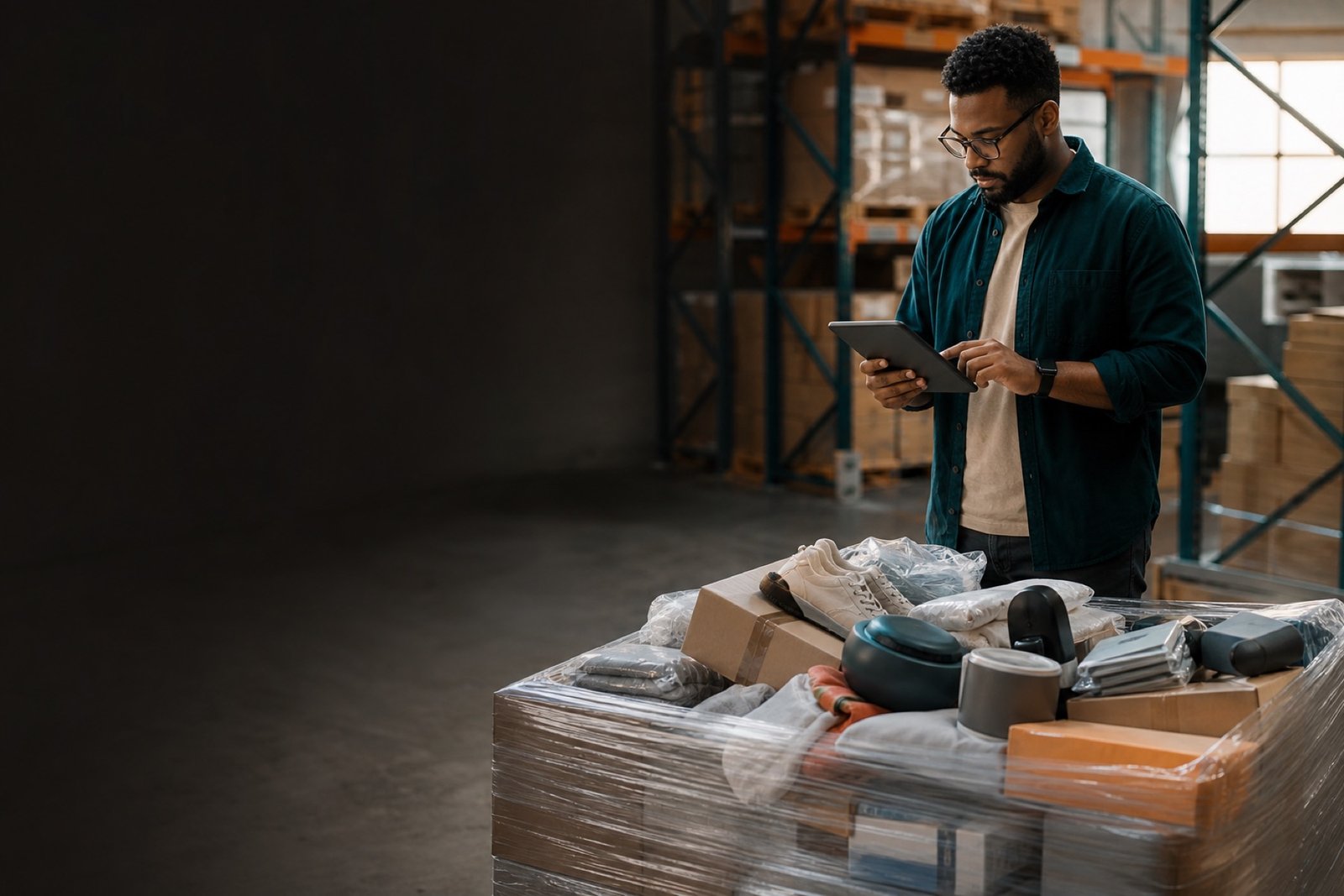
This is where we sit. We buy loads, break them down, apply a grade to what we can actually see, photograph the merchandise on the wood, and list the pallet at a price that does not grow at checkout. You give up the cheapest possible per-unit cost in exchange for knowing what you are collecting or having delivered. For a buyer taking one to five pallets at a time and processing them personally, that trade is usually the right one — mostly because your labor and your floor space are finite in a way a trailer buyer's are not.
Rule of thumb: the further upstream you buy, the more capacity you need to survive a bad load
| Channel | Typical unit | What you trade away |
|---|---|---|
| 🏭 Retailer bulk programme | Full trailers, contracted | Selection, and any ability to inspect first |
| 📦 Wholesale liquidator | Trailer to multiple pallets | Flexibility on quantity and timing |
| 🧑💼 Broker | One to many pallets, remote | Direct answers about the physical load |
| 🔨 Auction platform | Single lots, competitive | Price certainty once premiums and freight stack |
| 🏪 Stocked warehouse | One to five pallets, listed | The very lowest per-unit cost |
| 📱 Social media seller | Whatever is claimed | Recourse, records, and usually the photographs |
🕵️ The questions our own buyers ask before we pay
We buy loads too, and we get them wrong sometimes. The questions below are what we ask upstream, and they work just as well pointed at us. A seller who answers them plainly is worth staying with; one who deflects into brand names and estimated retail value is telling you something without meaning to. Notice that none of these questions are about price. Price is the easy part and the last part.
- Can you photograph this specific load, on the wood, today? A no is not automatically bad, but it changes what you should pay.
- What grade is on it, and who applied that grade — you, or the seller you bought it from?
- Did a manifest come with it, and is it a full list or a summary? Will I get it as received?
- Has this load been picked over since it arrived? Honest operations will tell you.
- What does it cost delivered to my postcode, including a liftgate if I have no dock?
- If it turns up materially different from the description, what is the process, and who do I speak to?
🚩 What we treat as a hard stop
- 📸 Photographs of an empty warehouse, a branded lorry, or a stock image instead of the merchandise.
- 🏷️ 'All brand new' with no grade attached, on a load described as returns.
- 🤝 Claims of an official partnership or authorised relationship with a named retailer.
- 📄 A confident piece count with no manifest behind it.
- 💸 Payment by irreversible transfer only, to a name that does not match the business.
- 🚚 A flat nationwide delivery figure quoted before anyone has asked where you are.
⚖️ Trademarks, affiliation, and what the evidence supports
Amazon and every other retailer or brand named on this page are trademarks of their respective owners, referenced only to describe merchandise that may be present in a lot. Pallets Stock Room is not affiliated with, endorsed by, sponsored by, or an authorised partner of Amazon or any other retailer. We describe a lot as marketplace or retailer returns only when the supplier gave us that as the source, and we pass on manifests exactly as we receive them. Where the evidence stops, our description stops too. Nothing on this page forecasts what a lot will sell for.
Tell us the category and how many pallets you can process. We will say what we have and what we do not.
Ask what is on the floor this week🎯 Matching the channel to your actual capacity
Be honest about three numbers before you choose where to buy: how many hours a week you can spend sorting, how much floor space you can keep clear, and how much cash you can leave tied up in unsold stock. Those three numbers decide your channel far more than any price comparison does. A buyer with ten hours a week and one garage bay should be taking a single graded pallet from a warehouse that answers the phone. A buyer with a unit, a jack, and two staff can go further upstream and absorb a bad load. Buying above your capacity is the most common and most expensive mistake in this trade.
🧭 A sensible first three purchases
Start with one graded lot in a category you already sell — footwear, apparel, tools, or home goods are the usual entry points because the failure modes are visible rather than electrical. Work it end to end and record your lane four share and your hours. Buy the second lot in the same category so you have something to compare. Only on the third should you change a variable, whether that is category, grade, or channel. Three lots is enough to know whether the maths works for you, and it is a far cheaper education than a trailer.
Where you buy matters less than whether you can clear what you bought
Every channel on this page has produced happy buyers and unhappy ones. The difference is almost never the channel. It is whether the buyer had the space, the hours, and the market to turn a wrapped block of merchandise into sold units before the next one arrived.
❓ FAQ
Where do you buy Amazon return pallets in practice?+
From liquidation sellers who buy bulk returns loads and break them into pallets — stocked warehouses, wholesale liquidators, brokers, and auction platforms. You cannot buy returns directly from a retailer's shelf, and no legitimate seller claims that route.
Are you an official Amazon liquidation partner?+
No. We are not affiliated with, endorsed by, or an authorised partner of Amazon or any other retailer. We describe sourcing only as our supplier described it to us, and we say so plainly when we do not know.
Is it cheaper to buy further up the chain?+
Per unit, usually yes. But upstream buying means full trailers, no inspection, and no ability to decline the mix. If you cannot receive, store, and clear that volume, the lower unit price is not a saving.
Why do auction prices look lower than listed pallet prices?+
Auction totals often exclude buyer's premiums, handling charges, and freight arranged after the sale. Add those before comparing. A listed pallet price with separately quoted delivery is frequently the same or less once everything is counted.
How do I check a seller before I pay?+
Ask for photographs of the actual load, the grade and who applied it, whether a manifest exists, and a delivered cost to your postcode. Sellers who answer those four questions directly are the ones worth buying from.
Do you sell single pallets or only bulk?+
Single pallets are listed and can be bought as they are. Multiple pallets and larger loads go through the bulk quote form so we can confirm availability and delivery before anything is committed.
Can I inspect a lot before buying?+
Collection buyers see the load at handover. For anything else, ask the desk for additional photographs of a specific lot and we will tell you what we can and cannot show.
Categories, quantity, delivery postcode or collection. That is all we need to give you a straight answer.
Start a bulk or multi-pallet enquiryReady to buy · transactional
Shop this guide — order pallets now
On-site listings and checkout paths referenced in this article.
Same topic · informational partner guide
Buy amazon return pallets online at PalletsSource
Same topic — online buying journey. Buy wholesale pallets online — listed price, checkout, Customer Care.
Buy amazon return pallets online at PalletsSourceSame topic · informational partner guide
Shop amazon return pallets with confidence at PalletsBay
Same topic — trust-first buying guide. Clear lots. Clear price. Confidence to buy.
Shop amazon return pallets with confidence at PalletsBayBuy on PalletsSource + PalletsBay · commercial + transactional
Order wholesale pallets on partner storefronts
Checkout, bulk quotes, and the same-topic guide on each partner domain.
More from the blog
Branded Clothing Pallets Compared: Lululemon, Nike, and Mixed Apparel Lots
Compare Lululemon-class, Nike clothing, and mixed apparel pallets at Pallets Stock Room — manifests, grades, −15% promo, and which lot fits your channel.
11 min read
Buy Amazon Pallets Online: Listed Prices, Clear Grades, Real CTAs
Buy Amazon pallets online with fixed wholesale prices — shop return lots, compare grades, checkout or quote. No bidding theater.
10 min read